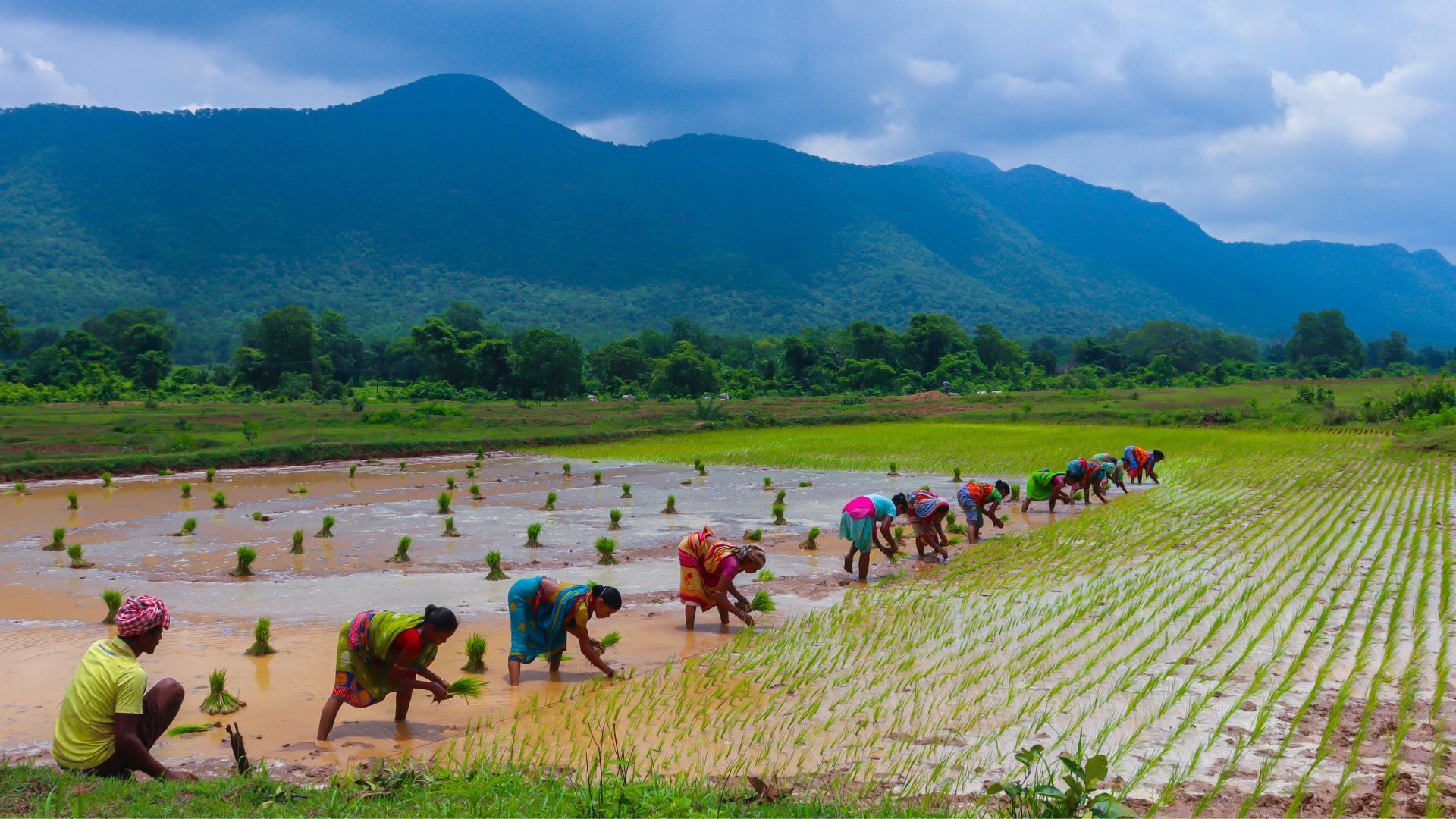
Climate-Resilient Agriculture
Farming systems that hold their own when the rains are late, the soil is depleted, and input costs are high. Tested across multiple geographies before we recommend them to farmers.
THE CHALLENGE
India's smallholder farmers have no margin for climate failure.
Four Pillars of Climate-Resilient Farming.
India's smallholder farmers are absorbing the full force of a changing climate: erratic monsoons, accelerating soil degradation, rising input costs, and falling yields, without the research infrastructure to know what actually works under stress.Relief measures ease the financial pressure, but the agricultural system underneath still has to change.
B2V works on that system, developing farming systems that build genuine resilience, ones that perform better under climate stress rather than merely surviving it.
"Natural farming plots showed 18% better moisture retention at 30cm depth during a late-monsoon year. That is a direct climate resilience improvement, measurable, replicable, and policy-legible."
B2V Research Team, Odisha Farm Trial 2023

WHAT WE DO
Four Pillars of Climate-Resilient Farming.
Each pillar addresses a specific mechanism through which climate change undermines smallholder productivity, and a specific evidence-based intervention that rebuilds it.

Natural Farming Systems
A 3-year phased transition from chemical to natural farming. Tested on our own research farm across 4 geographies before we recommend it to farmers. Includes Brahmi as an alternative crop during the transition.

Natural Farming Systems
A 3-year phased transition from chemical to natural farming. Tested on our own research farm across 4 geographies before we recommend it to farmers. Includes Brahmi as an alternative crop during the transition.

Natural Farming Systems
A 3-year phased transition from chemical to natural farming. Tested on our own research farm across 4 geographies before we recommend it to farmers. Includes Brahmi as an alternative crop during the transition.

Agroforestry Integration
Tree-crop integration for smallholder plots (0.5–3 ha) that improves soil carbon and income diversification without displacing food crops. Active pilots in Odisha and Bihar.

Agroforestry Integration
Tree-crop integration for smallholder plots (0.5–3 ha) that improves soil carbon and income diversification without displacing food crops. Active pilots in Odisha and Bihar.

Agroforestry Integration
Tree-crop integration for smallholder plots (0.5–3 ha) that improves soil carbon and income diversification without displacing food crops. Active pilots in Odisha and Bihar.

Community Water Management
Rainwater harvesting and watershed models grounded in both engineering and traditional water knowledge, addressing the rainfall variability climate change is accelerating.

Community Water Management
Rainwater harvesting and watershed models grounded in both engineering and traditional water knowledge, addressing the rainfall variability climate change is accelerating.

Community Water Management
Rainwater harvesting and watershed models grounded in both engineering and traditional water knowledge, addressing the rainfall variability climate change is accelerating.

Soil Health Regeneration
Bioinput-based restoration for chemically degraded soils, with community-produced inputs and 3-year monitoring of organic matter and moisture. 60% input cost reduction over the protocol period.

Soil Health Regeneration
Bioinput-based restoration for chemically degraded soils, with community-produced inputs and 3-year monitoring of organic matter and moisture. 60% input cost reduction over the protocol period.

Soil Health Regeneration
Bioinput-based restoration for chemically degraded soils, with community-produced inputs and 3-year monitoring of organic matter and moisture. 60% input cost reduction over the protocol period.
OUR WORK
See How We’re Powering Change

Organic Vegetable Cultivation and Market Linkage
Training smallholder farmers in organic vegetable production, establishing a primary processing centre, and creating direct market linkages to improve farmer incomes in Bihar.

Unnat Krushi Kendra (UKK)
A network of village-level farmer service centres built around locally trained agripreneurs, giving smallholder tribal farmers access to organic inputs, quality seeds, demonstration farms, and market linkages, and still running six years after the project closed.

Natural Farming and Agripreneur Development
Establishing community-based natural farming demonstration centres and building a cadre of micro agripreneurs to drive climate-smart agriculture adoption in Jharkhand.
Explore more Impact Stories
FAQs
Got questions?
We are here to make B2V easy to understand. Find answers to the most common questions below.
Still got questions?
How We Work
Impact & Research
Partner With Us
There is a persistent gap in rural climate work between the research that shapes policy and the implementation that happens in villages. B2V exists to close it, which is why we do both. Our field programmes generate real-world evidence, while our research helps improve implementation, inform policy, and enable others to replicate what works. Every intervention is an opportunity to learn, and every insight is used to improve outcomes for communities.
B2V combines long-term field implementation with rigorous research. We co-create models with communities, validate them across multiple locations, and continuously refine them using evidence. We build this work with others as much as with communities, partnering with government departments, fellow NGOs, research institutions and funders so that a model proven in one district can travel to the next. Our work spans climate resilience, regenerative agriculture, rural livelihoods, water security, entrepreneurship, and community institutions, allowing us to address interconnected challenges rather than isolated problems.
Communities are collaborators, not subjects. They help identify problems, shape solutions, test interventions, and provide continuous feedback throughout implementation. We work the same way with our partners, collaborating with local NGOs, community institutions, government line departments and research bodies at every stage. This participatory approach keeps our research practical, locally relevant, and grounded in lived experience.
Yes, where there is strategic alignment, strong local partnerships, and community readiness. We believe expansion should be intentional rather than opportunistic, ensuring that new programmes maintain the same quality, relevance, and long-term commitment as our existing work.
FAQs
Got questions?
We are here to make B2V easy to understand. Find answers to the most common questions below.
How We Work
Impact & Research
Partner With Us
There is a persistent gap in rural climate work between the research that shapes policy and the implementation that happens in villages. B2V exists to close it, which is why we do both. Our field programmes generate real-world evidence, while our research helps improve implementation, inform policy, and enable others to replicate what works. Every intervention is an opportunity to learn, and every insight is used to improve outcomes for communities.
B2V combines long-term field implementation with rigorous research. We co-create models with communities, validate them across multiple locations, and continuously refine them using evidence. We build this work with others as much as with communities, partnering with government departments, fellow NGOs, research institutions and funders so that a model proven in one district can travel to the next. Our work spans climate resilience, regenerative agriculture, rural livelihoods, water security, entrepreneurship, and community institutions, allowing us to address interconnected challenges rather than isolated problems.
Communities are collaborators, not subjects. They help identify problems, shape solutions, test interventions, and provide continuous feedback throughout implementation. We work the same way with our partners, collaborating with local NGOs, community institutions, government line departments and research bodies at every stage. This participatory approach keeps our research practical, locally relevant, and grounded in lived experience.
Yes, where there is strategic alignment, strong local partnerships, and community readiness. We believe expansion should be intentional rather than opportunistic, ensuring that new programmes maintain the same quality, relevance, and long-term commitment as our existing work.
Still got questions?
FAQs
Got questions?
We are here to make B2V easy to understand. Find answers to the most common questions below.
How We Work
Impact & Research
Partner With Us
There is a persistent gap in rural climate work between the research that shapes policy and the implementation that happens in villages. B2V exists to close it, which is why we do both. Our field programmes generate real-world evidence, while our research helps improve implementation, inform policy, and enable others to replicate what works. Every intervention is an opportunity to learn, and every insight is used to improve outcomes for communities.
B2V combines long-term field implementation with rigorous research. We co-create models with communities, validate them across multiple locations, and continuously refine them using evidence. We build this work with others as much as with communities, partnering with government departments, fellow NGOs, research institutions and funders so that a model proven in one district can travel to the next. Our work spans climate resilience, regenerative agriculture, rural livelihoods, water security, entrepreneurship, and community institutions, allowing us to address interconnected challenges rather than isolated problems.
Communities are collaborators, not subjects. They help identify problems, shape solutions, test interventions, and provide continuous feedback throughout implementation. We work the same way with our partners, collaborating with local NGOs, community institutions, government line departments and research bodies at every stage. This participatory approach keeps our research practical, locally relevant, and grounded in lived experience.
Yes, where there is strategic alignment, strong local partnerships, and community readiness. We believe expansion should be intentional rather than opportunistic, ensuring that new programmes maintain the same quality, relevance, and long-term commitment as our existing work.
Still got questions?
